
Is mat pilates or yoga enough? Why weight training changes everything | Dopamine Movement Singapore

By Dopamine Movement | Infrared Heated Mat Pilates Studio, Singapore
Mat pilates and yoga have never been more popular in Singapore. Studios are full, class waitlists are growing, and the results people are getting — better posture, less back pain, a stronger core — are real and well-documented.
But here's a question that comes up constantly, both in our studio and across fitness communities online: is mat pilates or yoga enough on its own?
The honest answer is: it depends on your goals. And for most people, the science suggests the answer is no.
In this post we'll break down exactly what mat pilates and yoga do well, where they fall short, and why combining them with weight training — even light, low-impact resistance work — produces results that neither discipline can achieve alone.
What mat pilates actually does to your body
Mat pilates was developed by Joseph Pilates in the early 20th century as a system of controlled movements designed to build core strength, improve postural alignment, and develop neuromuscular coordination — the ability of your brain to communicate efficiently with your muscles.
Modern sports science has confirmed what Pilates himself observed: his method is particularly effective at activating deep stabilising muscles that conventional gym training tends to ignore. These include the transverse abdominis (the deepest layer of your core), the multifidus (small muscles running along your spine), and the muscles of your pelvic floor and hip girdle.
A 2015 study published in the Journal of Bodywork and Movement Therapies found that eight weeks of mat pilates significantly improved core endurance, spinal flexibility, and balance in sedentary adults. A 2021 review in PLOS ONE confirmed that pilates training improves functional movement quality, reduces chronic lower back pain, and enhances proprioception — your body's ability to sense where it is in space.
These are meaningful, clinically significant benefits. For people recovering from injury, managing chronic pain, or returning to exercise after a long break, mat pilates is genuinely one of the best places to start.
What yoga does to your body
Yoga, particularly styles like hatha, vinyasa, and yin, develops flexibility, breath control, balance, and mind-body awareness. Regular yoga practice has been shown to reduce cortisol levels (the primary stress hormone), improve sleep quality, and increase joint range of motion.
A comprehensive 2016 review in the International Journal of Yoga found that consistent yoga practice improved flexibility by an average of 35% over 10 weeks, and significantly reduced self-reported anxiety and physical tension.
For nervous system regulation — the ability to shift out of fight-or-flight mode and into a calmer, more recoverable state — yoga is arguably unmatched among physical disciplines. This is why so many athletes and high-performance professionals use yoga as recovery and stress management, not just fitness.
So what's the problem?
Here's where the science gets important.
Both mat pilates and yoga are primarily bodyweight practices. They build relative strength — the ability to control and move your own body — but they provide limited progressive overload. Progressive overload is the fundamental mechanism by which muscles grow stronger and denser over time: you must consistently challenge your muscles with increasing resistance.
Without progressive overload, your body adapts to a training stimulus relatively quickly — typically within 6 to 12 weeks — and then plateaus. You continue to maintain what you've built, but you stop building new muscle tissue.
This matters significantly for three reasons.
1. Muscle mass and metabolism
Skeletal muscle is metabolically active tissue. The more lean muscle you carry, the higher your resting metabolic rate — meaning you burn more calories at rest, every hour of every day, simply by existing.
A landmark study published in the American Journal of Clinical Nutrition found that resistance training increased resting metabolic rate by an average of 7% over a 24-week period, with some participants showing increases of up to 15%. Bodyweight-only training produced no significant change in resting metabolic rate in the same study.
This is one of the most important and under-discussed findings in fitness science. If your goal includes changing your body composition — reducing fat, increasing definition, looking and feeling leaner — you need to build muscle. And to build muscle past the beginner stage, you need resistance training.
2. Bone density
This is particularly important for women, and particularly relevant in Singapore's ageing population.
Resistance training — applying mechanical load to the skeleton through weighted movement — is the most effective non-pharmacological intervention known to science for maintaining and building bone mineral density. Weight-bearing exercise stimulates osteoblast activity: the cellular process by which new bone tissue is laid down.
A 2019 meta-analysis published in the Journal of Bone and Mineral Research reviewed 22 studies and found that resistance training significantly increased bone mineral density at the lumbar spine and femoral neck — two of the most common sites of osteoporosis-related fracture. Yoga and pilates alone showed no significant effect on bone density in the same analysis.
Given that one in three women over 50 will experience an osteoporosis-related fracture, this finding has real long-term health implications. Starting weighted training in your 30s and 40s is one of the most effective things you can do for your health in your 60s and 70s.
3. Hormonal response
Resistance training triggers the release of anabolic hormones — primarily testosterone (yes, in women too, at lower levels), growth hormone, and IGF-1 (insulin-like growth factor). These hormones drive muscle protein synthesis, fat mobilisation, and tissue repair throughout the entire body.
Bodyweight training at low intensity does not reliably trigger the same hormonal cascade. The load simply isn't sufficient to produce the metabolic stress that stimulates these hormonal responses.
But isn't pilates already resistance training?
This is a fair question, and the answer is: partly, yes — but with limitations.
Mat pilates uses your bodyweight as resistance, which is meaningful — particularly for beginners. A standard plank, side-lying leg series, or hundred exercise creates genuine muscular demand. But once your body adapts to those movements (typically within 8–12 weeks of consistent training), the stimulus is no longer sufficient to drive further muscle development.
The classic progression problem in pilates is this: you get better at the movements, which means the movements get easier, which means the adaptation stimulus decreases. Without adding external resistance, you eventually reach a ceiling.
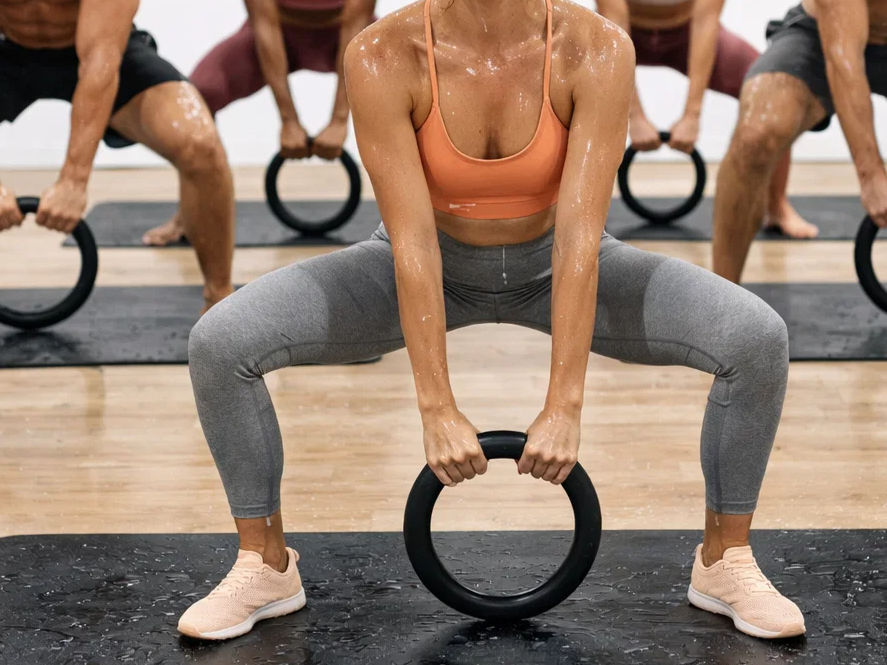
This is exactly why we use BALA equipment at Dopamine Movement — weighted bangles, bars, and resistance tools that add progressive load to pilates movements without changing their fundamental character. You're still doing pilates. You're still working with precision, control, and breath. But your muscles are working against meaningful resistance, which keeps the adaptation stimulus alive long after the bodyweight movements alone would have plateaued.
What about yoga and weight training?
The same principle applies. Yoga's profound benefits for flexibility, stress regulation, and joint mobility are genuine and well-supported by science. But yoga alone will not build the muscle mass needed to drive metabolic change, protect bone density, or significantly alter body composition in most people past the beginner stage.
The combination of yoga for mobility and recovery, and resistance training for strength and metabolic adaptation, is arguably the most complete physical training framework available. You get the nervous system benefits of yoga, the flexibility and postural work of pilates, and the metabolic and structural benefits of progressive resistance training — all in one integrated approach.
The research-backed case for combining all three
A 2020 study published in Medicine & Science in Sports & Exercise directly compared three groups over 16 weeks: yoga only, resistance training only, and a combined yoga-plus-resistance group. The combined group showed the greatest improvements across every measured outcome — including muscle strength, flexibility, body composition, and self-reported wellbeing. Neither single-discipline group matched the combined group's results in any category.
A similar 2022 study in the Journal of Strength and Conditioning Research found that adding resistance training to a pilates programme produced 40% greater improvements in muscle strength and a 22% greater reduction in body fat percentage compared to pilates alone, over a 12-week period.
The science is consistent: movement disciplines complement each other in ways that produce results greater than the sum of their parts.
What this looks like in practice
You don't need to overhaul your entire routine or spend hours in the gym. The most effective approach is surprisingly accessible.
Two to three sessions of resistance-integrated mat pilates per week is sufficient to drive meaningful muscle development, metabolic adaptation, and body composition change — provided the resistance is sufficient and progressive.
At Dopamine Movement, our Heated Sculpt classes are built precisely around this principle. We use BALA weighted equipment — bangles, bars, and resistance tools — integrated into mat pilates movements, performed in our infrared heated studio. The infrared heat deepens muscle activation, the pilates framework ensures precision and injury prevention, and the BALA resistance creates the progressive overload stimulus that drives real change.
The results our members see — leaner arms, stronger cores, better posture, improved mobility — are the direct product of this combination. Not one element alone, but all three working together.
Summary: what the science says
Mat pilates is excellent for core strength, spinal health, postural alignment, and neuromuscular coordination. It is not sufficient on its own for muscle hypertrophy, bone density maintenance, or metabolic adaptation past the beginner stage.
Yoga is excellent for flexibility, stress regulation, nervous system recovery, and joint mobility. It shares the same limitations as pilates when it comes to progressive overload and metabolic adaptation.
Resistance training — even light, low-impact resistance work using equipment like BALA weighted tools — provides the progressive mechanical stimulus needed to build lean muscle, support bone density, drive hormonal adaptation, and shift body composition in ways that bodyweight training cannot.
The most effective approach combines all three: the precision of pilates, the restorative properties of yoga, and the metabolic power of resistance training.
Ready to experience the combination?
At Dopamine Movement, we've built our entire class programme around this exact philosophy. Our infrared heated mat pilates and sculpt classes combine pilates precision with BALA resistance training in a deeply effective, accessible format — 45 minutes, several times a week, in the heart of Singapore's CBD at Raffles Place.
Whether you're a pilates regular who has noticed a plateau, a yoga practitioner curious about adding strength work, or someone new to structured movement entirely, our classes are designed to meet you where you are and take you further.
View our schedule and book your first class at dopaminemovement.com.
Dopamine Movement is Singapore's infrared heated mat pilates and sculpt studio, located at 15 Philip Street, Tan Ean Kiam Building #09-00, Raffles Place. We use exclusive BALA equipment from the United States. Classes run daily, 45 minutes, suitable for all fitness levels.
New to infrared pilates? Read our complete guide: What is infrared heated pilates?


Comments